
Sandplay Therapy For Children
By Anatta (Anna) Zarchi
Learning how to verbally express yourself is something that slowly develops as you get older. This is mainly because your vocabulary and emotional understanding expands through new experiences and interactions. As a result, talk therapy for young children can sometimes be tricky: they might not yet know the words they need to express themselves, or don’t have enough understanding of what is happening and what they’re truly feeling. They might also not yet understand that something they’re experiencing isn’t right, such as bullying, and so they don’t express it, even if it’s causing them emotional turmoil. This isn’t to say talk therapy isn’t effective at all, but sometimes, other forms of therapy can be more suitable, or can help prompt children to say more about what they’re experiencing.
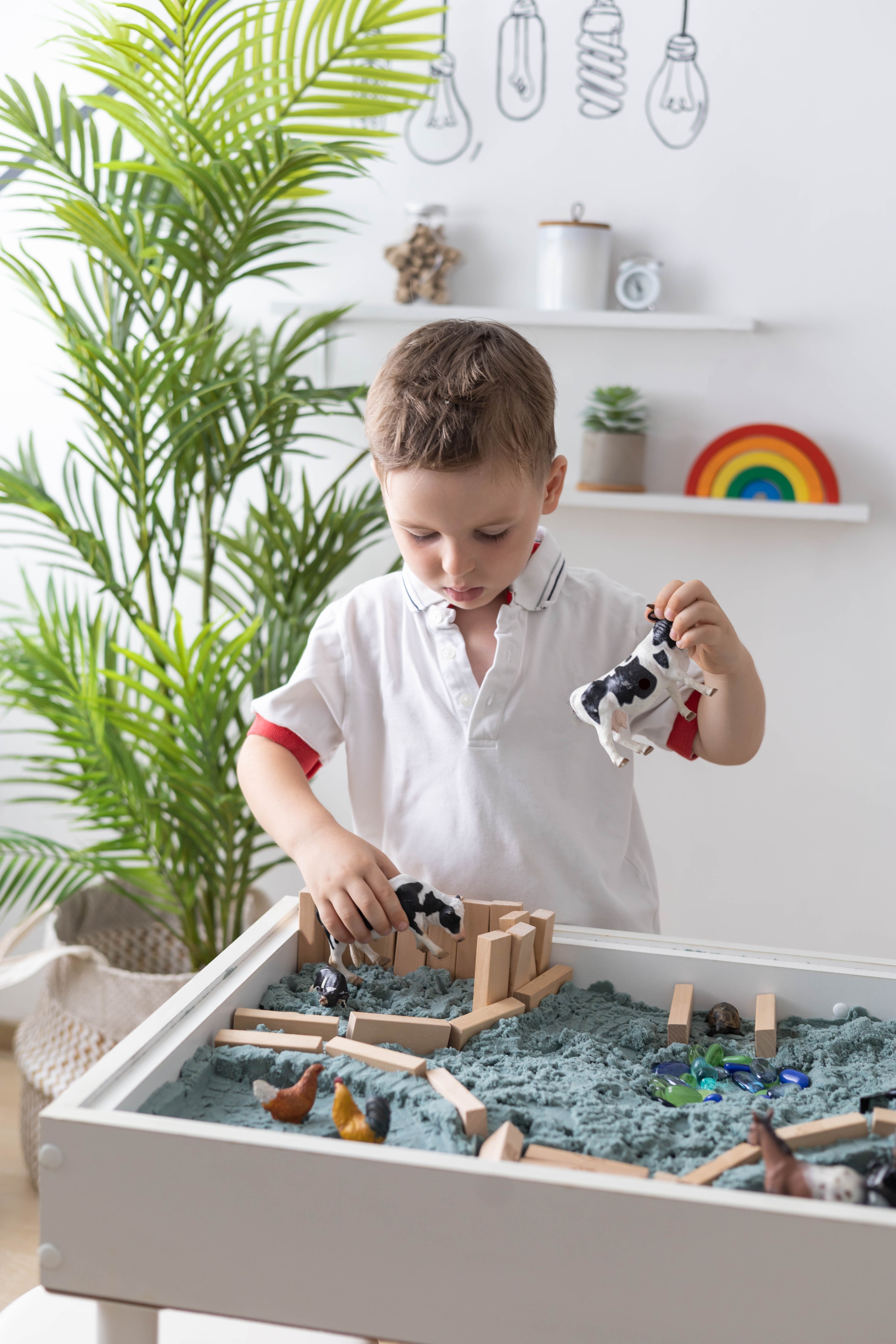
One such modality is sandplay therapy, a type of therapy which centers around a tray of sand and different toys and figurines. Think of it like this: what each child does within the tray is like an external manifestation of their inner world. Essentially, the child gets to express themselves through playing rather than through words, which helps the therapist to gain a glimpse into the child’s inner world, including their thoughts, emotions, and experiences.
Sandplay therapy in action
Let’s look at a made-up example: one girl’s parents and teachers notice that she’s suddenly become very withdrawn and fearful, appearing scared and nervous in interactions and always walking with her head down. She had always been quiet and independent, but until recently had never appeared scared and had always held her head up. When questioned, she said she didn’t have any friends, but didn’t reveal that anything was wrong. The parents brought her to see a sandplay therapist.
The therapist asked her to choose a few figurines to create whatever scenario she wanted. The child started playing a game in which she was a princess, using a Sylvanian Families rabbit in a dress to represent herself, fighting “bad guys”, which she chose to represent with a witch and a vampire. The therapist asked what the bad guys had done, to which the child responded, “They are very mean.” Suspecting that the “bad guys” might be representations of her classmates, the therapist then asked, “Are your friends at school mean too?” The child appeared reluctant to answer, and simply said, “Sometimes.”
Over the next few sessions, as more trust was built, the child revealed the names of the bad guys, which corresponded with the names of certain classmates. As she did not want to talk about her classmates directly, the therapist asked her what kind of mean things the bad guys in her game had said or did, to which she replied, “They say horrible things to the princess and make everyone hate her.” This prompted the therapist to ask if that meant the princess was all alone, and she said “Yes.”
Your child’s confidentiality is important
Situations like this are quite common, and sandplay therapy can help children express things that they’re scared to say, or, in other cases, simply don’t know how to say. It’s important to keep in mind that confidentiality applies with children and adolescents as much as adults, and therapists will not share any specific information shared by a child without their consent.
However, the therapist can give general updates on the child’s well-being in order to guide parents and teachers—if the school is involved—on how to best care for the child. For example: “She’s getting better at expressing herself now, I think it would be helpful to speak to her in a more gentle tone both at home and at school,” or “He’s feeling a little down at school lately, if he brings it up, I’d recommend listening to him with an open mind and responding with understanding, as that will help him feel comfortable.”
Though it’s natural to want to know more, it’s good to remember that children have the right to their own thoughts and emotions, and respecting that can help them feel more comfortable.
Choosing the right sand
There are three types of sand commonly used in sandplay therapy, and each one can be helpful in different ways:
Dry sand: Soft and smooth, good for expressing ideas freely with little effort, and often used in creating a backdrop or scene for the playing to take place.
Wet sand: Mainly used for shaping and building things, such as some types of solid structure. It is often linked to issues of control, stability, or holding things in place. Wet sand is also suitable for expressing more intense emotions as it requires force.
Kinetic Sand: Soft and stretchy, which can help calm and soothe.
The meaning behind the miniatures
Aside from the types of sand, it’s also important to have a wide variety of figurines to choose from, so that the child can accurately choose something that represents their emotions. For example, there might be figurines representing different professions, human and non-human figurines, popular characters from media, figurines with emotional expressions, or figurines with different bodies, hair types, skin colors, and so on. The wider the variety, the more options there are for the child to express themselves.
As seen from the example above, the child attributes meanings to the figurines, so a different child might attribute different meanings to the same figurines. It’s not that each figurine is a direct representative of good or bad, rather, it is up to the therapist to explore what that choice means to each child. While the child in the example used a Sylvanian Families rabbit to represent herself and a witch and vampire to represent her bullies, a different child might do the opposite. For someone else, a witch might be a good thing, and a gang of Sylvanian Families dolls could be something less positive.
Playing comes naturally to children, and sandplay therapy effectively utilizes this as a form of therapeutic support that feels natural and fun, as opposed to something that they do not understand which is being forced upon them. This can help reduce resistance, and make the process easier for children.
Not just for kids
Finally, I’d like to conclude by saying that even though sandplay therapy is often associated with children, it can also be helpful for adults and adolescents who are looking for an alternative to talk therapy or who have trouble expressing their emotions through words—as is art therapy. So if you’re interested in non-talk therapy, you could always give this a try. We might primarily associate the word “play” with children, but play therapy can be for anyone, no matter how old they are.
About the Author
Anna works for New Counseling Service (NCS), an internationally recognized mental health center in Bangkok with a diverse team of licensed counselors. NCS has provided counseling services in Thailand and surrounding regions for over 20 years, with therapists specializing in a wide variety of issues such as anxiety, depression, work stress, relationships, and more. For more information visit ncsbkk.com/ncs/