
A Piece of Pie
By Rachel Ofo
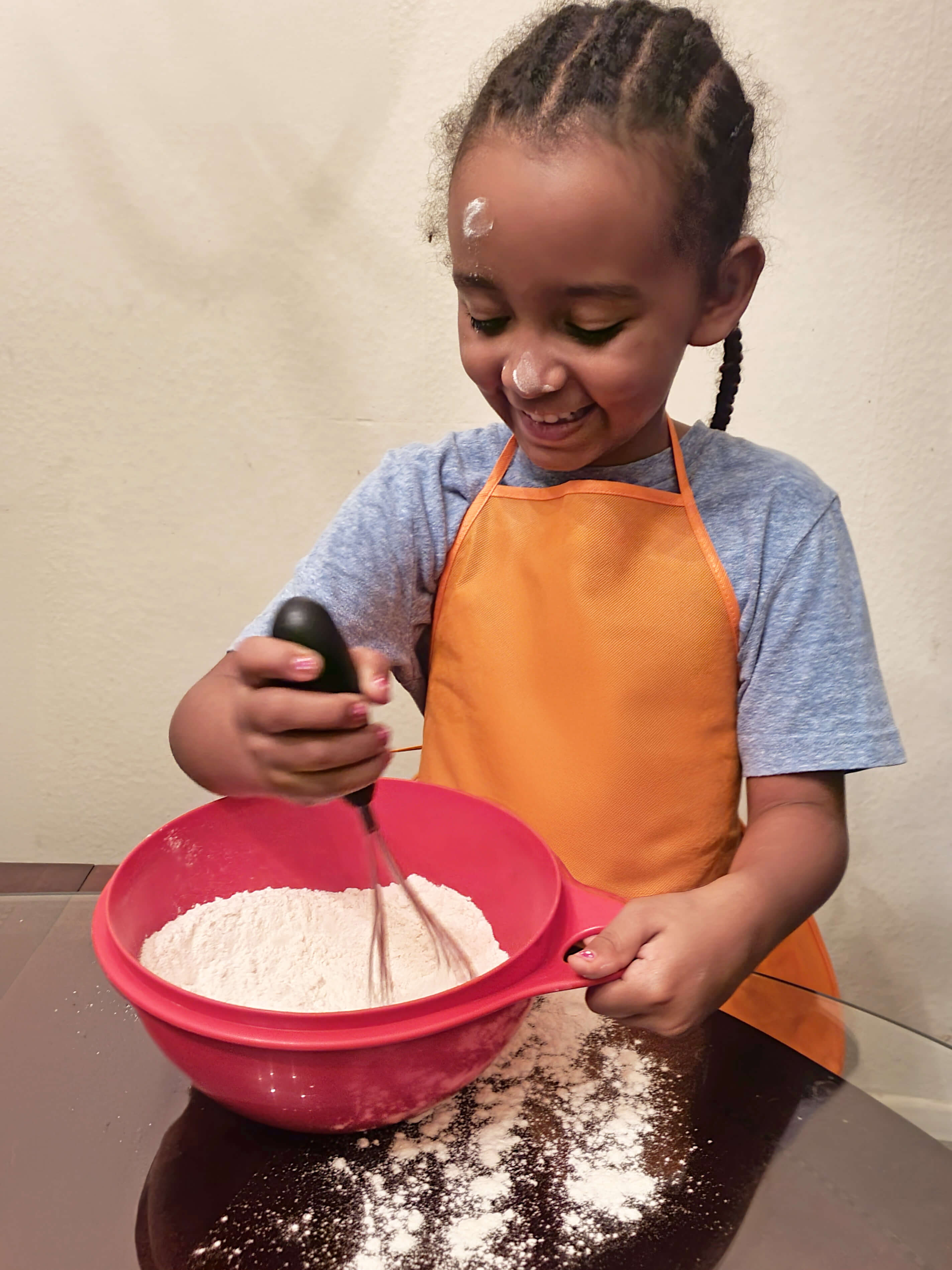
The end of the year brings family, parties, and lots of baking. Sometimes, all three are combined. This means children in the kitchen, which may or may not be as fun for you as it is for them. I got the idea to bake an apple pie for the first time and asked my daughter to help. Of course she wanted to. So there I was afterwards, recipe time doubled, kitchen looking like a snowstorm had hit it, and wondering if it was worth it.
It’s always worth it. Introducing children to baking offers many benefits, ranging from physical, cognitive, and emotional gains to building healthy habits and life skills. Baking with children proves to be a handy tool for promoting healthy development, despite the stress of flour tornadoes and sticky fingers.
Fine motor skills and coordination
Baking with children enhances fine motor skills by strengthening the little muscles in their hands and fingers through tasks like measuring, kneading, and even cleaning up afterwards. These activities also improve hand–eye coordination and dexterity, which can help with their writing and functional tasks in daily life. Additionally, the sensory processing involved with handling ingredients is always a win; maybe Jack Horner was on to something! We love fun learning.
Cognitive development
Baking introduces children to math and science in a fun, hands-on way. Weighing ingredients, counting eggs, and timing the oven practice basic math skills, while mixing and observing reactions, like dough rising, introduces scientific concepts. By adjusting recipes and measuring ingredients, children learn fractions, proportions, and arithmetic intuitively. Baking also encourages curiosity about science, offering a pressure-free environment where children experiment, observe results, and reinforce cognitive development while enjoying themselves and your company.
Emotional and psychological benefits
Whenever my daughter does anything in the kitchen, she ensures that everyone we meet knows about it. Allowing your children to join in kitchen activities offers emotional and psychological benefits for children, fostering creativity, patience, and a sense of accomplishment. Baking can give children a sense of control and boosts self-esteem as they witness the results of their efforts. Additionally, baking with others promotes emotional bonding, communication, and teamwork, while creating lasting memories. My daughter wants to be included when we’re cooking and as an added bonus, most of the time, she’s interested in eating what we’ve made.
Healthy habits
Another baking benefit for kids is the increased awareness of what goes into their meals and their mouths. Children preparing food may have a more willing and positive attitude about trying more nutritious foods, encouraging healthier choices. We’re in the process of planting a “winter vegetable” garden. Having my daughter plant the veg, watch them grow, then pick and use them for baking and cooking will hopefully reverse some of the poor eating habits I allowed during her toddler years. It’s never too late to begin building healthy foundations.
Lifelong skills
I cook and bake several times a week. This is mainly due to the fact that my mom always invited me and my siblings into the kitchen. And if we weren’t around for the cooking, we were there to clean up afterwards. By the time we were pre-teens, we could whip up some eggs in the morning and noodles in the afternoon with no problem. Knowing how to bake equips children with life skills and fosters independence, as children learn to follow instructions, make decisions, and manage their time. Also, understanding the importance of cleaning up helps with hygiene. These skills contribute to a sense of self-reliance.
Overall, baking with children offers amazing benefits that extend beyond the kitchen. It’s an enriching activity that nurtures children’s overall development, helping them to build life skills and confidence that will help their future selves. So throw on that apron (or not), make some pie, and embrace the beautiful and beneficial mess of baking with the kids!
Apple pie
For this pie, I followed the School Night Vegan recipe below, adjusting a handful of ingredients. Be sure to check the website to view the full recipe, along with notes and comments. Also, some may wonder if this recipe is tasty for non-vegans. Trust me, you won’t regret this! Top with your favorite ice cream, whipped cream, or just plain cream.
Equipment
- Large saucepan with lid
- Baking tray
- Large bowl
- Knives or a pastry cutter
- Measuring jug
- Spatula
- Rolling pin
- Oven
- 9-inch (23-cm) pie tin
Ingredients
Super flaky vegan pie crust
360 g plain white (all-purpose) flour
1 tablespoon caster (superfine) sugar
1 teaspoon fine sea salt
250 g vegan butter block type, fridge-cold
2 tablespoons vodka or white vinegar, ice cold
100 ml water, ice cold
2 tablespoons soy milk or any plant milk
2 tablespoons Demerara sugar
Vegan apple pie filling
2 kg baking apples
Juice and zest of half a lemon
190 g light brown sugar
150 g granulated sugar
5 tablespoons plain white flour
Pinch flaky sea salt
1 teaspoon ground cinnamon
¼ teaspoon ground nutmeg
1 teaspoon vanilla extract
Abbreviated instructions
- Prepare the filling!
- Make the pastry.
- Fill and seal the pie! I love doing a lattice top, but you can also just roll your pastry into a circle and top with a full layer. Just be sure to make steam holes.
- Bake away! Because we pre-baked our pie filling, you'll see this pie doesn't take quite as long as others.
Full recipe
School Night Vegan (2022) Vegan Apple Pie by Richard Makin. schoolnightvegan.com/home/vegan-apple-pie/
About the Author
Rachel Ofo moved from the US to Bangkok in 2016 and spent six and a half years there. She has a daughter, whom she loves dragging around on various adventures like hikes and fishing trips. In her free time, she enjoys reading, watching movies, and trying new restaurants. She also enjoys being out in nature.