
Is it Worth the Risk?
By Sarah Russell
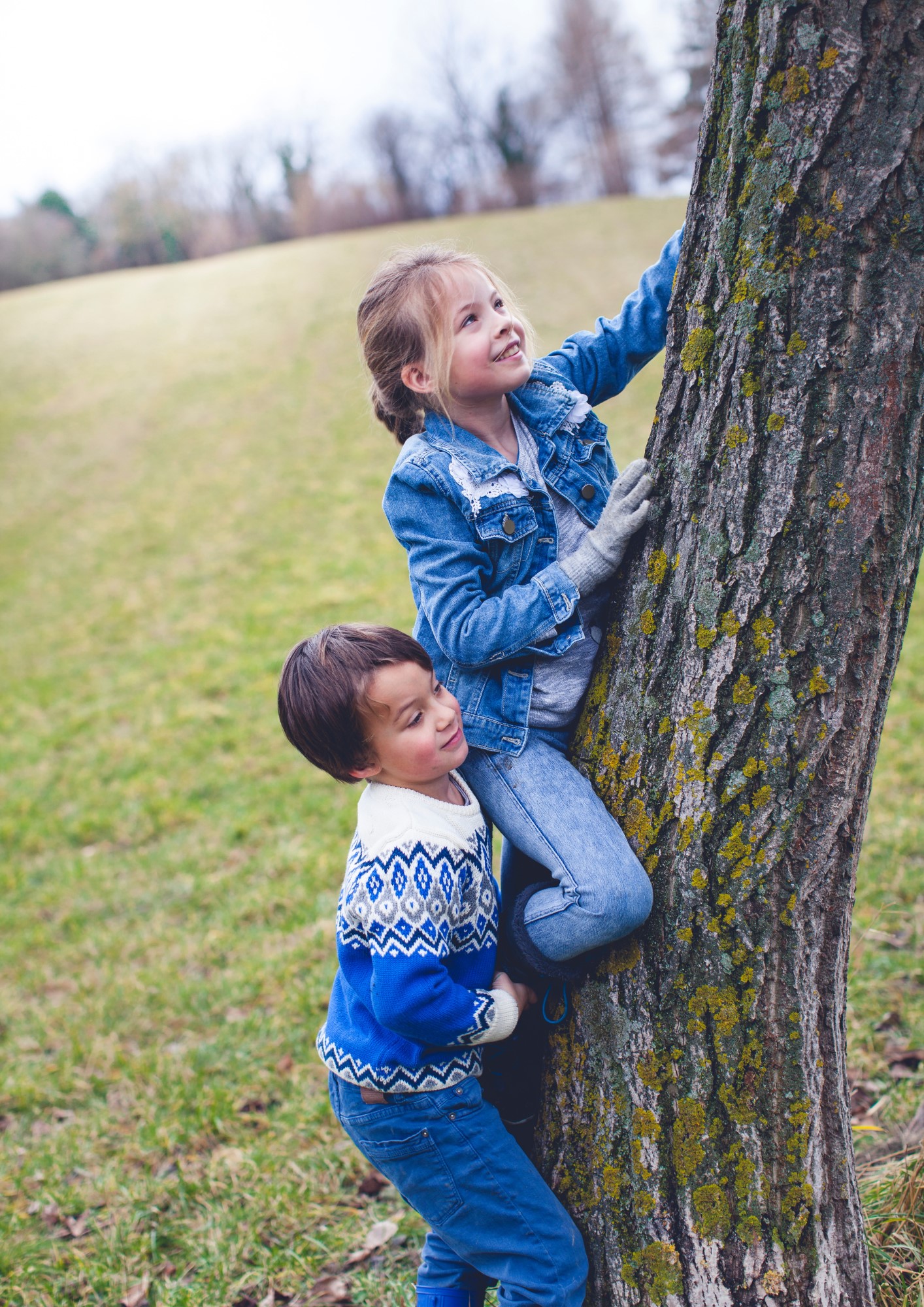
I often spend time (holding my breath and crossing my fingers) watching my two young boys climb trees, jump from heights, and race around on their bikes and scooters, rolling down ramps and curbs at top speeds. Many times, when their play has felt challenging and uncomfortable, I’ve had to remind myself that play is crucial for children's well-being. In fact, not only is play fun for children, it is beneficial to their physical, mental, and social development and well-being (1).
Since having my second child, who’s even more physical and active than my first—with a streak of thrill-seeking, my need to embrace play categorized as “risky play” has evolved into a passion, both personally and professionally. I’ve leaned into the idea that there’s an abundance of learning opportunities for children within risky play: physical activity, social opportunities, recognition of strengths and capacity, opportunity for energetic / emotional output, development of motor skills, teamwork, awareness of their body, creativity, and sensory exploration.
I’ve also learned that allowing our children to embrace their own experiences and desires often requires us to examine our preconceived thoughts and opinions. I hope this information helps you, like it did for me, embrace risky play with more of an understanding of and greater confidence in the benefits of this type of play for children.
What is risky play?
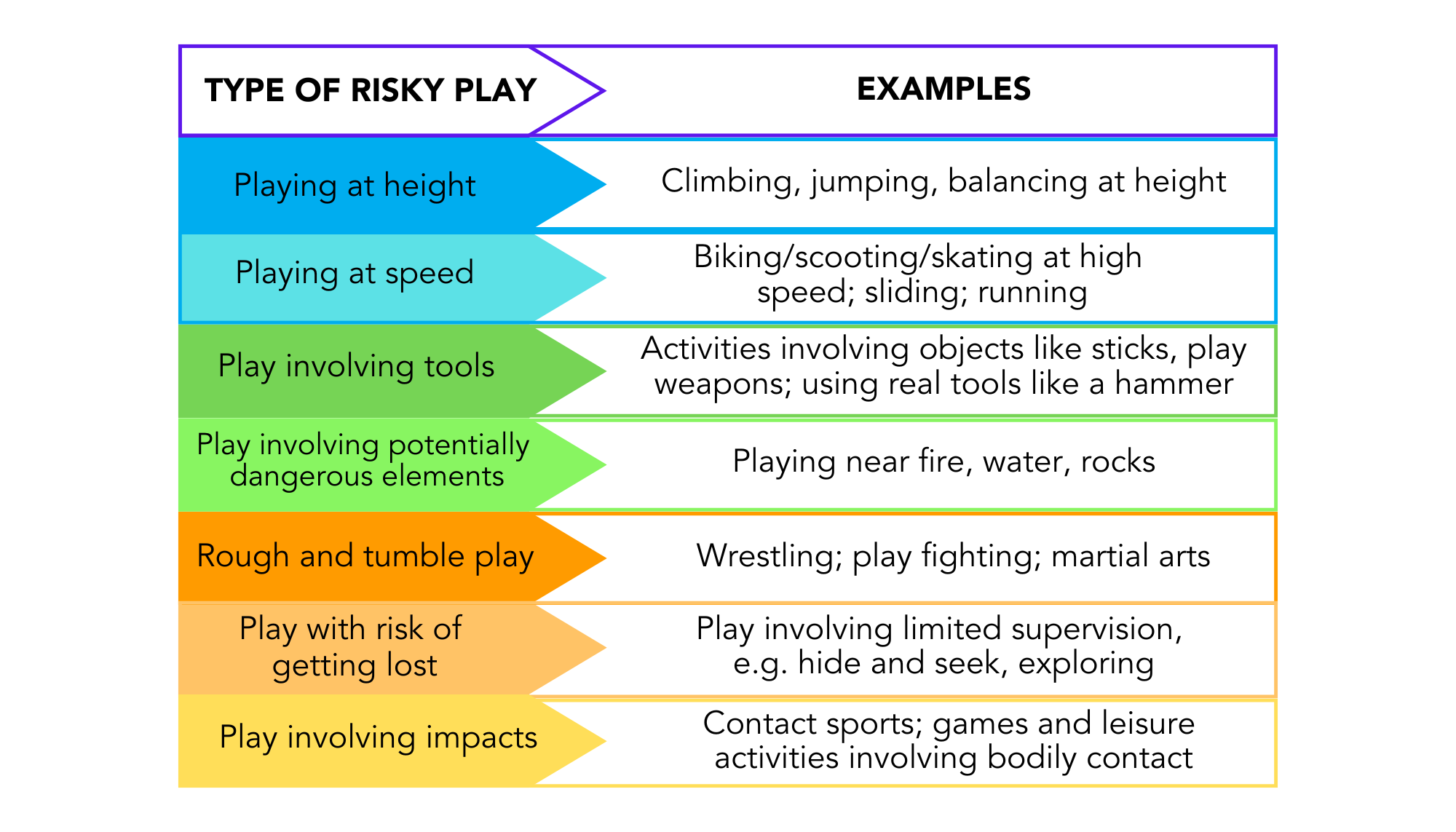
Risky play is characterized by thrilling and exciting forms of free play that involve inherent risks, such as the potential for physical injury, due to the uncertain nature of the activity. Figure 1 highlights the types of risky play and some examples of each (2).
What are the benefits of risky play?
In Southeast Asia, where attitudes to play are more cautious, the idea of "risky play" may seem counterintuitive. However, recent research suggests that allowing children to engage in age-appropriate risk-taking activities can have significant benefits for their physical, cognitive, emotional, and social development (3):
Physical development: Risky play helps children develop strength, coordination, balance, and agility. It also provides opportunities to develop gross motor skills and spatial awareness.
Cognitive development: Engaging in risky play requires children to assess risks, make decisions, and problem-solve. This helps them develop critical thinking skills and improve their ability to learn from their mistakes.
Emotional development: Overcoming challenges and fears associated with risky play can boost children's self-confidence, resilience, and sense of accomplishment. It also helps them develop emotional regulation skills and learn to manage their own anxiety.
Social development: Risky play often involves social interaction and cooperation, such as playing with friends or siblings. This can help children develop social skills, communication skills, and the ability to plan, problem-solve, negotiate, and compromise.
What are the risks?
Risky play wouldn’t have the name it does if it didn’t come with risks! And while it's one thing to understand the benefits, it’s certainly another to feel comfortable allowing and supporting a child to participate in this type of play. Research into risky play indicates that the most impactful parental fear is the fear of serious injury (4). However, the vast majority of risky-play-related injuries result in minor injury that requires little to no medical input (5).
How can I embrace risky play but minimize risk?
Each family will have their own level of comfort with the risks associated with different types of risky play. It's also important to respect the cultural values and concerns among your community; not everyone will be comfortable with risky play. While keeping our children safe is of utmost importance, research suggests that families today are imposing too many restrictions on risky outdoor play, which may hinder children's development (5). It’s therefore important to still find ways for your child to explore risky play as well as minimize the risks to their safety:
Start small: Begin with low-risk activities and gradually increase the level of challenge as your child gains confidence and competence.
Provide supervision: While it's important to allow children some autonomy, adult supervision is crucial to ensure their safety and allow you to intervene if and when necessary.
Adopt a paradigm shift—from keeping children “as safe as possible” to “as safe as is necessary”.
Teach safety skills: Explain to your child the importance of assessing risks, making safe choices, and using appropriate safety gear, such as helmets and protective clothing.
Reframe “be careful” to more specific and informative language, such as “pay attention to the log in front of you” or “that tree branch looks weak and unstable”. This will encourage safety awareness and problem-solving skills.
Encourage communication: Talk to your child about their experiences with risky play. Ask them about the challenges they faced, how they overcame them, and what they learned from the experience.
Risky play opportunities in Bangkok
There are countless opportunities for risky play in Bangkok, especially outdoors:
- Take advantage of the endless sunshine: Invite your child to ride a bike, scooter or skateboard, or roller-skate (depending on developmental stage, of course!) in one of the many parks, especially parks with tailored ramps and slopes.
- Climb trees: Choose trees with sturdy branches and low-hanging limbs to minimize risks.
- Balance / walk on and jump off logs: Look for fallen logs in parks or nature reserves. Start with short distances and gradually increase the challenge as your child gains confidence.
- Build forts: Encourage your child to build forts using natural materials like sticks, leaves, and mud. This can foster creativity and problem-solving skills.
- Play-fight with sticks, branches, large leaves, or materials from tree trunks: Try to blunt the end of sticks or help your child select blunt sticks. Discussing shared rules around areas appropriate to strike at and words that cease play immediately can help children feel more safe and secure.
- Explore surrounding areas: Weekend getaways provide fabulous opportunities to explore some of the beautiful nature surrounding Bangkok. Rivers, farms, and camping grounds provide lots of opportunities for exploration and creativity.
If you still feel unsure about risky play, one of the various outdoor playgrounds with swings, slides, and climbing apparatus might offer safer opportunities for your child to explore play with risk. And if outdoor spaces aren’t right for you, indoor play centers such as Bounce or Harborland also encourage risky play.
Key takeaways
Risky play involves challenging activities with a perceived risk of injury, like climbing trees, building forts, or playing near water.
Risky play is beneficial: it helps kids learn, grow, and become more resilient.
Any child can engage in elements of risky play appropriate to their development.
The occurrence of injury requiring medical attention as a result of risky play is minimal.
Risky play is an excellent chance to teach your child about risk assessment. Help children understand and manage risks by helping them develop an awareness of perceived risk, for example, “The rocks are slippery, hold on,” or “Pay attention to the broken tree branch when climbing the tree.”
Not everyone in your community will feel comfortable with risky play. If this is the case, you can try creating risky play opportunities with just a particular few friends.
Remember: Risky play is a natural part of childhood development. By providing a supportive and encouraging environment, you can help your child reap the many benefits of this important type of play.
Disclaimer: This information is for general knowledge and guidance only. It does not constitute professional medical or child-development advice. Always prioritize the safety and well-being of your child.
About the Author
Sarah Russell is an Australian-trained pediatric occupational therapist with almost 20 years of experience. She has worked in diverse settings including tertiary hospitals, private practices, and schools across Australia, Singapore, and Thailand. She is passionate about respecting and protecting childhood through play. To contact Sarah, please email stamburrini@gmail.com.
References
Help Me Grow (n.d.) Why Unstructured Play Is Important to Child Development. Accessed on 19 January 2025 from: helpmegrowmn.org/HMG/HelpfulRes/Articles/WhyUnstructure/index.html
Beaulieu, E., & Beno, S. (2024) Healthy childhood development through outdoor risky play: Navigating the balance with injury prevention, Canadian Paediatric Society. cps.ca/en/documents/position/outdoor-risky-play
Brussoni, M., Olsen, LL., Pike, I. & Sleet, DA. (2012) Risky play and children's safety: balancing priorities for optimal child development. Int J Environ Res Public Health. 9(9):3134-48.
Oliver, BE., Nesbit, RJ., McCloy, R. et al. (2022) Parent-perceived barriers and facilitators of children’s adventurous play in Britain: a framework analysis. BMC Public Health 22, 636.
Brussoni, M. (2015). What is the Relationship between Risky Outdoor Play and Health in Children? A Systematic Review. International Journal of Environmental Research and Public Health. 12(6):6423-6454.