
Color Inside the Lines: The Difference Between Creativity and Discipline
By Kit Lang
“Coloring outside the lines” has become a hallmark phrase for creativity; generating new ideas, breaking conventions, and being free in our thinking. However, as an art educator for more than 15 years, I would argue that coloring inside the lines is a good thing.
Creativity and discipline are not the same, but both are essential to artistic development. There is a common misconception that artistic talent is inherent: either you have it or you don’t. In reality, artistic skills develop much like those of an athlete, musician, or mathematician: through instruction, practice, repetition, and application.
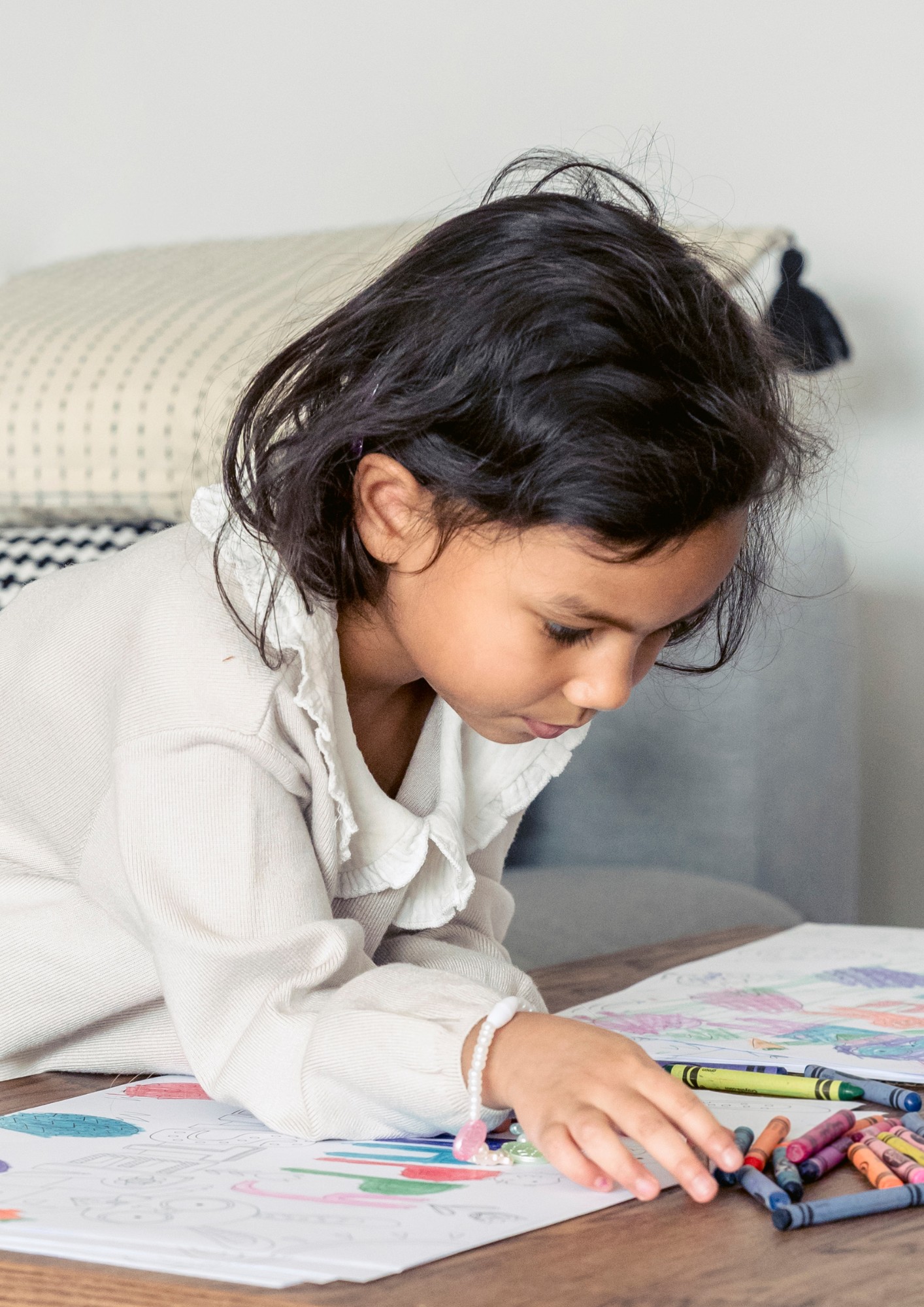
For young children, coloring inside the lines is one way to develop many foundational skills. It helps refine fine motor control, teaches children how much pressure to apply to a medium, and builds spatial awareness and hand-eye coordination. These aren’t limitations on creativity; they are tools that can eventually give children greater freedom to express their creativity.
Even a simple coloring page can offer opportunities for both discipline and creative decision-making. Children can explore positive and negative space, decide what to color and what to leave untouched, experiment with pressure to create tone and value, and make choices about color, texture, and pattern. The physical lines may establish boundaries, but what happens within those boundaries can still be wonderfully individual.
And once children have developed greater control of their tools? Then let them color outside the lines.
The goal isn’t to teach children that good art means staying within prescribed boundaries. It’s to help them develop the skills and confidence to decide when those boundaries are useful and when they’re ready to break them.
So encourage children to color inside the lines. Help them build fine motor skills through patience, practice, and discipline. Then give them opportunities to explore, experiment, play, and create.
Discipline builds the skills. Creativity gives children the freedom to decide what to do with them.
About the Author
Kit Lang has worked in art education for over 20 years, teaching at large international schools and developing children’s programming with a variety of institutions. Having lived in Asia for over 15 years, she enjoys exploring the cities she has lived in and traveled to through art, culture, and family life.